Heat Ageing and the Slow Crack in Poor Insulation
A sheath does not fail in one hot afternoon. It loses elongation a fraction at a time, and by the time a crack appears the material has been past its limit for years. The manufacturer publishes the numbers that bracket that process: a tensile strength of at least 8 N/mm² and an elongation of at least 125% before ageing, against an ambient ceiling of +90 °C and a reported elongation of up to 185%. The laboratory runs tensile testing after ageing as one of its standing tests.
Key takeaways
- Published mechanical floor on the 1500 V cable: tensile strength ≥8 N/mm² and elongation ≥125% before ageing.
- EN 50618 asks for more than 125%; the manufacturer states its PV cables typically reach up to 185%.
- Published temperature envelope: −40 °C to +90 °C ambient, +120 °C for 20,000 hours and +250 °C for 5 seconds on short circuit.
- The 2,000-hour xenon lamp test arranged on the company's cables is equivalent to about 360 weathering cycles.
What heat ageing does to a polymer
Heat gives polymer chains enough energy to move, and in the presence of oxygen that movement ends in chemical change: the chains cross-link further in some places and break in others. The visible result is a material that has lost its ability to stretch. Engineers describe that loss with elongation at break, the percentage a test piece stretches before it tears, and the reason it matters is that a cable on a rack is constantly being deformed by clips, wind and thermal movement. The same is true of all solar cables, and it is why the sheath rather than the copper usually decides whether a string is still sound in year fifteen.
Once elongation falls below the point where the material can follow the movement, the sheath cracks. The crack starts at a stress point, usually under a clip or at a bend, and then water enters. Water reaching the insulation is the beginning of the electrical failure that follows. None of that is visible on an installation walk-through until the last stage.
The published numbers that bracket the process
The 1500 V product page states an ambient range of −40 °C to +90 °C. It gives short-circuit values of +120 °C sustained for 20,000 hours and +250 °C for 5 seconds. Those three figures describe different regimes: the ambient figure is where the cable is expected to live, the 20,000-hour figure is a long thermal event, and the 5-second figure is a fault.
Mechanically, the same page publishes a tensile strength of at least 8 N/mm² and an elongation of at least 125% before ageing. The manufacturer states that EN 50618 asks for more than 125% elongation and that its PV cables typically sit about 20% above the requirement, reaching up to 185%. That margin is the material's reserve against the slow loss described above. The construction that carries it is published by KUKA CABLE as tinned copper, class 5 flexible according to IEC 60228, inside an electron-beam cross-linked XLPO insulation and sheath, and the standards named alongside are TUV 2PfG 1169/08.2007, EN 50618:2014 and IEC 62930.
Why the after-ageing test is the one that counts
An as-delivered elongation figure describes a new cable. The interesting number is what remains after conditioning. The laboratory's published test list includes tensile testing after ageing for exactly that reason, and the list also names cold bending, cold elongation, abrasion, solderability, static flexibility, water resistance and construction and dimensional testing.
The equipment that produces these numbers sits in a laboratory established in December 2015 and described as an ISO/IEC 17025 facility. Its environmental work includes a 2,000-hour xenon lamp exposure, equivalent to about 360 weathering cycles, which simulates intense sunlight together with humidity and ozone. That is a combined ageing test: heat alone is not the only attack, and a compound that resists one may not resist the other.
The published conditions in one table
| Condition or test | Published value | Page carrying it |
|---|---|---|
| Ambient temperature range | −40 °C to +90 °C | /products/1020.html |
| Short-circuit temperature, 20,000 h | +120 °C | /products/1020.html |
| Short-circuit temperature, 5 s | +250 °C | /products/1020.html |
| Vertical flame test | 800 °C for one minute, expected to self-extinguish | /the_tests/ |
| Xenon lamp UV test | 2,000 hours, about 360 weathering cycles | /the_cable_lab/1909.html |
| Elongation required by EN 50618 | more than 125% | /the_cable_lab/1909.html |
Where poor insulation starts to fail first
- Under a clip, where the sheath is pressed against a rail and cannot relax.
- At a tight bend, if the published rule of 4 × the outer diameter has been ignored.
- At a termination, where the cable is bent by hand whenever the circuit is isolated.
- On the sun-facing run, where surface temperature runs above the ambient air temperature for hours a day.
Each of those points is a place where a cable with little elongation left will crack before a cable that still stretches. That is why the published 185% figure is worth reading as reserve capacity rather than as a marketing number: the further a compound starts above the 125% requirement, the longer it survives the loss that heat and UV impose. The manufacturer keeps a topic section that sets out construction and the consequences of cutting corners.
Worked example
Compare the two elongation numbers. If a compound starts at 185% and the requirement is more than 125%, the headroom is 60 percentage points, which is the result of subtracting 125 from 185. That subtraction is the author's own arithmetic on published figures. If ageing removed 2 percentage points a year, the cable would stay above the requirement for about 30 years, which is the author's own illustration and not a prediction from the manufacturer.
Now look at the temperature side. The ambient ceiling is +90 °C, and the short-circuit figure is +250 °C for 5 seconds. The difference of 160 °C exists for 5 seconds only, which is why a fault is survivable while a persistent hot joint is not. A joint running 30 °C above ambient every day spends years working through reserve that a fault spends in seconds.
Frequently asked questions
Which published figure shows how well a PV cable resists heat ageing?
The elongation figure gives the clearest single view. The 1500 V cable is published with an elongation of at least 125% before ageing, and the manufacturer states its PV cables typically reach up to 185% against the more than 125% that EN 50618 requires. A higher starting value leaves more reserve as the compound ages in service.
Is the 2,000-hour xenon lamp test only about sunlight?
No. The manufacturer describes it as simulating intense sunlight together with humidity and ozone, and states it is equivalent to about 360 weathering cycles. Heat, moisture and ultraviolet radiation act on the compound at the same time, so the test combines several ageing routes rather than isolating one of them.
What to check before accepting a PV cable
Ask for the elongation figure and the standard it is measured against, then ask whether the value is the as-delivered one or a value measured after conditioning. Both numbers are useful, but they answer different questions, and only one of them says anything about year ten.
Then confirm the compound and the exposure the cable will actually see: an ambient ceiling of +90 °C assumes airflow, and a cable bundled in a tray runs hotter than the published ambient figure. Where the answer is not on the sheet, ask the supplier, because the site publishes no warranty terms and no performance promises beyond the test values quoted here.
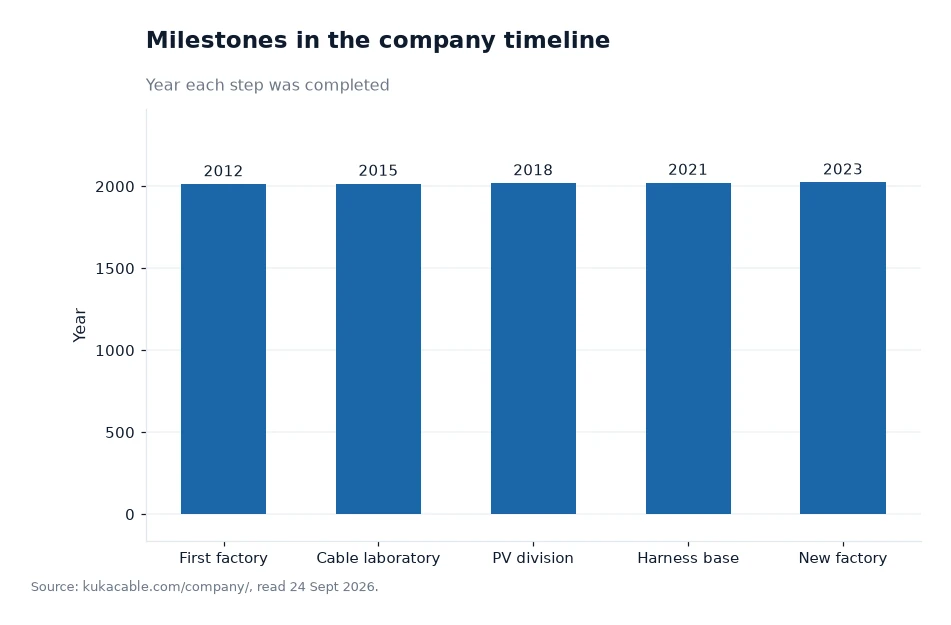
Heat-ageing behaviour and the timeline years both come from the manufacturer's own website, kukacable.com, consulted 24 Sept 2026[1].