Importing tile for a project combines product selection, technical evidence, appearance approval, quantity planning, packaging, freight, and receiving. Buyers should compare the same tile type and intended use across offers, check the scope behind grade claims, approve samples and batch expectations, and match the shipment documents to the selected product. A clear sequence from specification to delivery makes it easier to resolve questions before pallets are booked or installation begins.
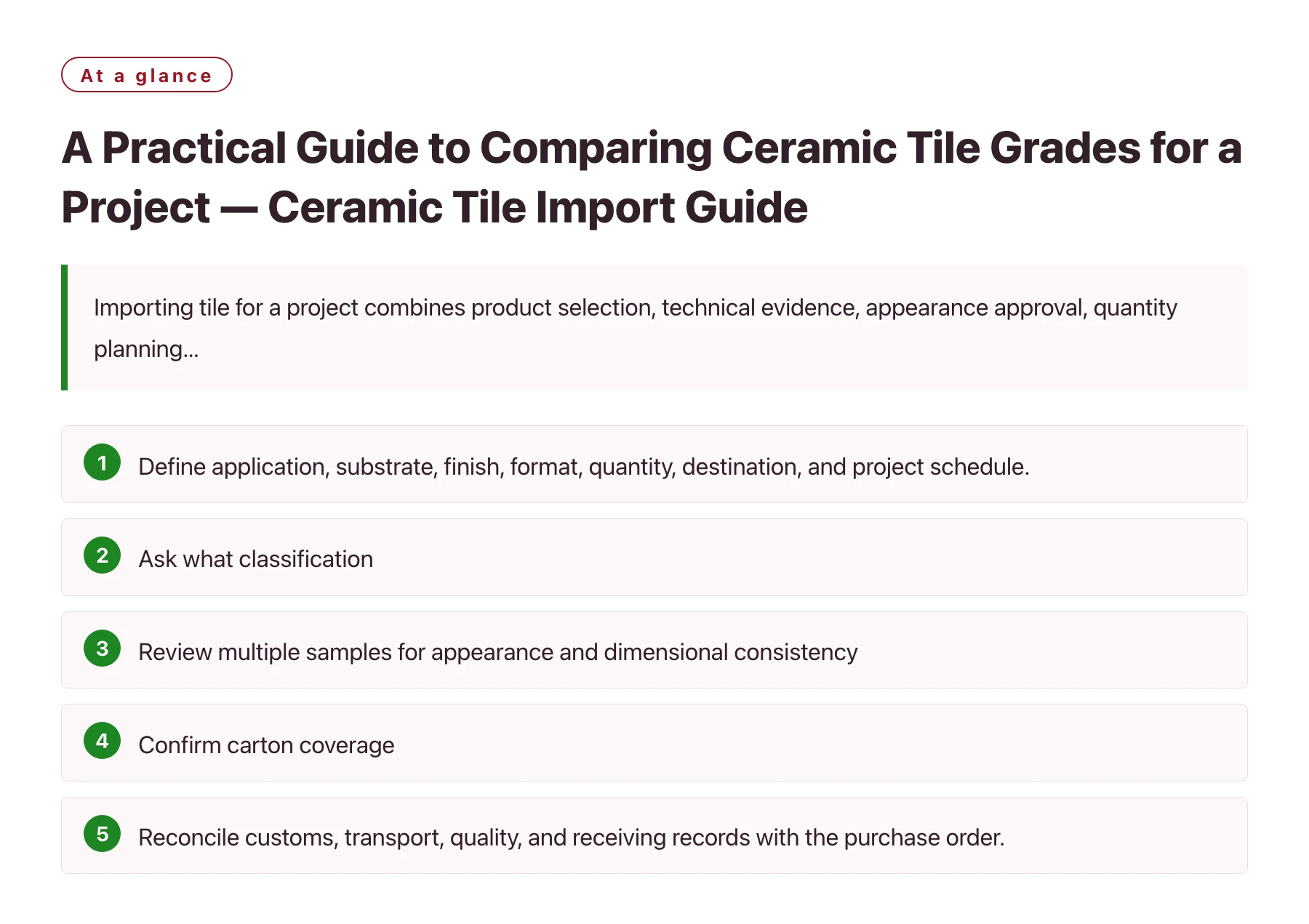
Key takeaways
- Define application, substrate, finish, format, quantity, destination, and project schedule.
- Ask what classification, declared characteristics, and test records support each tile grade.
- Review multiple samples for appearance and dimensional consistency, then record the approved lot expectations.
- Confirm carton coverage, pallets, packaging, handling, storage, and breakage procedures.
- Reconcile customs, transport, quality, and receiving records with the purchase order.
A grade label is only one part of the decision; import planning must preserve the identity and condition of the selected product.
Define the tile and its application
List where tile will be installed, the substrate, exposure, traffic, wet or exterior conditions, cleaning needs, and project destination. Ask the designer, architect, or engineer to specify the performance characteristics and installation constraints. Different rooms or uses may require different products even when the color and surface look similar. Note whether special trims, steps, mosaics, or edge pieces are included.
Specify product code, format, thickness, finish, color, surface texture, edge, and acceptable visual range. State quantities by room or phase and identify design drawings and revisions. Include grout joint and layout assumptions where they have been set by the installer. Do not allow a supplier to treat a catalogue family as a precise specification if several sizes and finishes are available.
Buyers comparing Foshan ceramic tile grades and packaging should send the same product brief to each candidate and ask for separate pricing on alternates. Label decisions as fixed, preferred, or open so the supplier can state exactly what is being quoted and what additional review is needed.
Compare classification, declared properties, and test evidence
Ask the supplier to define each commercial grade term and name the classification system or standard used. Request the version, product scope, declared characteristics, marking information, and any exclusions. ISO 13006:2018 defines terminology and classification, characteristics, and marking requirements for ceramic tiles within its scope, and references ISO 10545 test procedures. Its stated exclusions mean the project team should check whether the exact product and intended use are covered. [1]
Build a comparison table for the properties selected by the project professional. Depending on use, this could include dimensions, water absorption, breaking strength, surface quality, abrasion, chemical resistance, or other declared characteristics. Ask for source reports or declarations and verify that they identify the exact product code, size, finish, sample, method, date, and issuing organization.
A report for a related product is not automatically applicable to the offered tile. If a supplier cites a family test, request its scope or an explanation of how the tested sample represents the quoted configuration. Route standards interpretation and code requirements to a qualified technical reviewer. Do not treat a grade name as proof that every project requirement is satisfied.
Review samples and production variation
Request several pieces from a representative production batch where possible. Compare tone, pattern repeat, gloss, texture, edge, dimensions, and visible defects under consistent light. Record the sample supplier, product code, date, shade, caliber, and lot. Retain a marked reference sample or clear photographs that show the accepted range. One tile cannot reveal variation across a room or shipment.
Ask how shade and caliber are identified on cartons and whether the offered stock is from one batch. Confirm the supplier’s process for reserving quantity and how any later production lot will be compared. For phased construction, coordinate deliveries by area and installation sequence. If future matching matters, discuss reserve stock before purchase rather than assuming the same appearance will remain available.
Check the fit of trims, corners, skirting, transitions, and accessory pieces against the field tile. Review how they will be packed and identified. A sample approval should specify which components and attributes it covers and list unresolved test or document questions. Keep any approval condition attached to the purchase order.
Calculate quantities and normalize quotations
Have the estimator or installer calculate required area, cuts, layout pattern, breakage allowance, reserve cartons, and special pieces using the project drawings. Confirm pieces or area per carton, units of measure, pallet count, gross weight, and whether partial cartons are available. Ensure the supplier’s quotation uses the same unit and conversion method as the buyer’s order spreadsheet.
Compare offers for the same product code, classification, size, finish, shade expectations, quantity, packaging, inspection, and delivery point. Separate tile price from samples, tooling, trims, packaging, palletization, testing, freight, insurance, and destination charges. State quote validity, currency, minimum order, payment timing, and exclusions. Ask suppliers to list substitutions as alternatives.
Check whether additional quantity can be held from the same batch and under what commercial conditions. Consider the project’s schedule and storage capacity before buying reserve stock. Record who owns excess cartons and how they will be labeled and protected.
Specify packaging for tiles and accessories
Define individual protection, separators, carton strength, edge protection, pallet dimensions, straps, stretch wrap, moisture protection, and pallet marks based on product fragility and route. Confirm that cartons support the planned stacking and handling. Ask for package drawings or photos of a representative packed pallet and check the actual dimensions and weight against container and warehouse constraints.
Require marks that identify product code, size, finish, shade or lot, quantity, purchase order, and destination project where appropriate. State whether pallets may mix products, variants, or batches. If they may be mixed, specify how cartons are segregated and labeled. Clear marks reduce receiving delays and help preserve installation continuity.
Consider the full route: factory loading, consolidation, port handling, ocean or air transport, customs, warehouse, truck, and jobsite. Confirm whether packaging remains protected during storage and whether the receiving site has forklift or unloading equipment. If moisture or long storage could affect materials or packaging, obtain product-specific instructions from the supplier and technical owner.
Plan export, import, and shipping documents
Create a document checklist for quotation, purchase order, commercial invoice, packing list, origin information, transport documents, product records, and any market-specific declarations or permits. Assign each item to a named party and set a deadline before cargo handoff. Match seller, buyer, manufacturer, product code, quantity, packaging units, and destination across the files.
Work with a qualified customs broker to determine tariff classification, valuation, origin treatment, taxes, and required entry data for the destination. These items depend on jurisdiction and current rules. Do not copy an old declaration from another shipment if the product, country, or importer differs. Ask the broker to review descriptions before the invoice is finalized.
Confirm who arranges pickup, export clearance, freight, insurance, import clearance, unloading, and final delivery. State the applicable delivery term and exact named place in the contract. Ask the forwarder to quote against actual carton and pallet dimensions, weight, stackability, and delivery dates. A factory price alone does not describe the full landed cost.
Coordinate inspection and shipment release
Define checks for model identity, dimensions, appearance, quantity, packaging, carton labels, pallet condition, and any other project-specific characteristic. State inspection timing, sample method, acceptance criteria, required photographs, and who reviews the report. If a test is needed, identify the laboratory, method, sample, and decision owner before production.
If a finding occurs, record affected product, lot, cartons, evidence, and proposed corrective action. Decide whether goods are held, repacked, reworked, replaced, or released under an approved deviation. For high-impact differences, obtain a written decision from the authorized buyer or technical reviewer and arrange re-inspection when required.
Before dispatch, reconcile the approved product, batch or shade, inspection disposition, carton count, invoice, packing list, transport booking, and delivery appointment. Keep the approved sample and document revisions with the order record. Tell the forwarder and site receiver about any special stacking, unloading, or storage needs.
Prepare receiving and installation handoff
Reserve unloading equipment and storage space according to pallet dimensions and gross weight. Confirm delivery time windows, site access, and the person who can sign for the cargo. Instruct the receiving team to verify model and lot marks, counts, visible damage, moisture, and broken cartons before moving goods into installation areas. Preserve packaging identifiers while claims or quality questions remain open.
Distribute shade and caliber information to the installer and agree how cartons from the same room or area are staged. Do not mix unidentified pallets in a way that makes lot traceability impossible. Set aside reserve cartons with product, batch, and location references for future maintenance.
Record damage and shortages with photographs, carton labels, pallet references, and delivery documents. Notify the carrier, supplier, broker, or insurer within applicable contract deadlines. Keep affected goods isolated until the project’s technical owner determines whether they can be installed.
Close the project record after delivery
Store the selected specification, supplier quotation, approved sample, test evidence, batch details, packaging plan, inspection report, shipping documents, and receiving record in a single product file. Label current and superseded versions. This lets the project team identify what was ordered and what actually arrived.
After installation, record breakage, shade differences, shortages, delivery timing, and any issue with dimensions or accessories. Tie each observation to location, lot, installer note, and available photographs. Use the information to improve later takeoffs and supplier questions, while recognizing that one shipment does not establish performance for every tile product.
Sources
Frequently asked questions
Can I choose a ceramic tile based only on its grade?
No; use grade terms as one input. Compare the classification scope and declared characteristics with the application, market, sample, finish, installation requirements, and project specification.
How do I know a test report applies to my tile?
Match manufacturer, product code, size, finish, sample identity, test method, date, and stated scope to the exact offer and project use.
Should all tiles for a project come from one batch?
For visually continuous areas, discuss shade and caliber control with the supplier and installer. Plan phasing and reserve stock around available lot information.
What matters most when importing tile?
Keep product identity, quantity, packaging, required evidence, customs data, delivery terms, inspection results, and receiving plans aligned from order through installation.