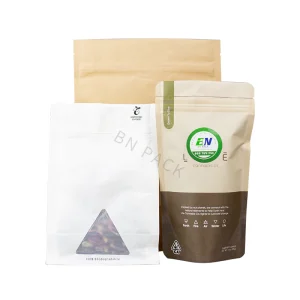
Personalized coffee packaging should protect aroma, manage carbon dioxide after roasting, seal reliably, fit the exact fill weight, and give buyers useful product information without crowding the design. A practical 250 g or 340 g retail pouch often combines a high-barrier film, one-way degassing valve, resealable zipper, tear notch, heat-sealed top, batch-code area, and clear roast information. Because normal air contains about 20.9% oxygen, limiting oxygen entry after packing matters for roasted coffee quality. Material choice should also account for food-contact rules, printing, shipping, local recycling systems, and the filling process rather than appearance alone.
Roasted coffee keeps changing after it leaves the roaster. Carbon dioxide formed during roasting continues to leave the bean for days, while oxygen entering the package promotes oxidation of aromatic oils and volatile compounds. A pouch therefore needs low oxygen transmission, low water-vapor transmission, sound seals, and enough mechanical strength for transport. In normal atmospheric air, oxygen is about 20.9% by volume, so a poorly sealed package is exposed to a large oxygen source every time air moves through a leak or weak closure.
Packaging specifications should be matched to the coffee rather than copied from another product. Whole beans, ground coffee, dark roasts, light roasts, decaffeinated coffee, and flavored coffee can behave differently during storage. A roaster packing beans 24 hours after roasting may require more gas-management capacity than a business packing coffee after a longer resting period, which is why the valve, headspace, fill level, and sealing process should be considered together.
A one-way degassing valve is useful for many freshly roasted whole-bean products because it allows internal gas to leave without functioning like an open vent. The valve also helps keep the pouch from swelling during warehouse storage and parcel shipping. Placement matters: a valve positioned too close to a zipper, side seal, artwork element, or filling zone can make production and package use less convenient.
The package still depends on the heat seal above the zipper. A zipper is mainly a consumer closure after opening; it does not replace the original production seal. For a 250 g or 500 g coffee pouch, enough material must remain above the zipper for heat sealing and enough space must remain below it for the customer to grip the opening. A tear notch should sit between the top seal and zipper so the customer can remove the sealed strip without cutting through the reclosure.
Package size also changes how the coffee looks and behaves inside the pouch. A 100 g sample, 250 g retail pack, 340 g or 12 oz pack, 500 g bag, and 1 kg foodservice pack should not simply use the same pouch dimensions with different fill amounts. Roast degree affects bean density, while whole beans occupy a different volume from ground coffee. Physical filling tests with the actual coffee are more useful than selecting dimensions only from a supplier’s capacity chart.
A bag described as “250 g capacity” is not automatically suitable for every 250 g coffee. Internal volume, bottom gusset depth, zipper position, roast level, and required headspace can change the fit even when the net weight is identical.
The structure should also match the way the package will be displayed. Stand-up pouches work well for many retail packs because the bottom gusset supports shelf presentation. Flat-bottom formats provide a broad front panel and several printable faces, while side-gusset bags remain common for larger coffee packs. A 1 kg wholesale bag may place more emphasis on filling speed and storage efficiency than a 200 g gift pouch designed for a specialty shop.
Printing should then be built around the physical package. A front panel usually has limited room, so the brand name, coffee name, origin, roast information, net weight, and a short flavor description should be given visual priority. Secondary details such as producer information, processing method, brewing guidance, website information, certification marks, and storage instructions can move to the back or side panels.
A useful information layout might look like this:
| Printed area | Information that fits well |
|---|---|
| Front | Brand, coffee name, origin, roast, net weight |
| Side | Variety, altitude, process, producer |
| Back | Brewing guidance, company details, storage information |
| Coding area | Roast date, lot number, best-before date |
| Near valve | Keep major text and scannable codes clear |
Color consistency becomes more important when a roaster sells several coffees under one brand. Digital printing can suit smaller runs and frequent artwork changes, while other printing methods can become more economical at larger volumes. A brand selling 8 rotating single-origin coffees, for example, may keep the same typography and layout while changing one controlled color field or illustration for each origin. This reduces the chance that the range looks like unrelated products.
Variable printing can extend personalization further. A coffee subscription can print customer names, a wedding supplier can produce event-specific packs, and a corporate gifting company can run several client designs without changing the basic pouch structure. Since 2020, shorter digital print runs have become increasingly common in flexible packaging applications, making limited seasonal editions and small SKU quantities easier to manage than older high-volume-only production models.
QR codes can carry information that does not fit comfortably on a pouch. A code can open a brewing guide, producer page, roast profile, subscription page, or product information page. The printed code should be tested on the finished material because matte coatings, reflective surfaces, folds, and low contrast can reduce scan reliability. A code that works on a PDF proof is not sufficient evidence that it will scan consistently after printing, filling, and pouch deformation.
Food-contact suitability needs equal attention. In the United States, packaging materials used for food applications fall within FDA food-contact requirements under Title 21 of the Code of Federal Regulations. In Europe, Framework Regulation (EC) No 1935/2004 and Regulation (EU) No 10/2011 are commonly relevant references for food-contact materials and plastics. Buyers should request documentation that applies to the exact film, ink, adhesive, coating, valve, and closure combination being ordered.
Sustainability claims require similar precision. A pouch can use less material than a rigid container but still be difficult to process in some municipal systems if it combines several incompatible layers. Mono-material structures and recyclable pouches may offer a better route where collection and recycling infrastructure accepts the specific material. The word “recyclable” should describe the complete package configuration, not only one film layer while ignoring the zipper, valve, coatings, or local collection rules.
Regulatory expectations are also changing. The EU’s Packaging and Packaging Waste Regulation, Regulation (EU) 2025/40, introduced a newer framework for packaging design, recyclability, waste reduction, and labeling across the European market. Brands selling into several countries should therefore avoid printing broad environmental statements until the material structure and the applicable market requirements have been checked.
Shipping requirements can change the preferred structure again. Coffee sold through e-commerce may pass through automated sorting systems, cartons, mailers, and repeated handling before reaching the customer. A 340 g pouch that looks good on a store shelf can still fail if its corners puncture easily or the top seal opens under compression. Drop, compression, seal, and filled-pack transport tests are more informative than evaluating empty samples by hand.
The secondary package should be considered at the same time. Reducing pouch dimensions by even 10% can sometimes allow a smaller mailer or carton, depending on the fulfillment setup. The real saving is not only film area; parcel dimensions, void fill, carton use, warehouse space, and packs per shipping case can all change when the primary package becomes more compact.
Production equipment imposes another set of limits. A manually filled micro-roaster may tolerate greater variation in pouch opening and stiffness, while automated lines need tighter control over dimensions, film behavior, seal temperature, zipper position, and valve placement. Before approving 10,000 or 50,000 custom bags, running filled samples on the actual sealer or filling line can identify problems that cannot be seen in artwork proofs.
The same applies to batch coding. Roast date, lot number, and best-before information are often added after the pouch is printed, so the artwork should reserve a clean coding area. Inkjet and thermal-transfer systems need compatible surfaces; dark graphics, heavy texture, or glossy coatings can reduce legibility. A production team should test the exact coding system before the final print run rather than adding an empty rectangle and assuming every printer will work on it.
For consumer use, the opening sequence should remain simple: remove the top strip, open the zipper, take out coffee, close the zipper, and store the package. A 2024 retail design may use sophisticated artwork, but poor zipper alignment or a tear notch placed inside the seal area can make the bag harder to use than a plain stock pouch. Packaging engineering and graphic design therefore need to use the same dieline from the beginning.
A practical specification sheet can include:
-
Fill weight: 250 g, 340 g, 500 g, or 1 kg
-
Coffee form: whole bean or ground
-
Packing interval after roasting
-
Required shelf-life period
-
Film structure and thickness
-
Oxygen and moisture barrier data
-
Valve type and position
-
Zipper and tear-notch position
-
Heat-seal conditions
-
Printing method and artwork tolerance
-
Roast-date and lot-code area
-
Food-contact documentation
-
Recycling or disposal instructions
-
Filled-package dimensions
-
Shipping and storage conditions
-
Planned order quantity
Ordering decisions become easier when each item is tied to a measurable requirement. A supplier can compare two materials by transmission data, seal range, thickness, print performance, or test results; “premium feel” provides no measurable production specification. A buyer comparing a 100-micron structure with a thinner alternative should ask how barrier, puncture resistance, seal strength, weight, and end-of-life route change rather than assuming the thicker film is automatically better.
Sample approval should use filled packs, not only flat samples. Testing 20, 50, or 100 filled pouches from a production trial can reveal inconsistent seals, zipper problems, valve placement errors, scuffing, code legibility issues, and dimensional variation before a large commercial run. The trial should use the intended coffee weight, sealing equipment, coding process, carton, and storage method.
For a multi-SKU range, one tested pouch architecture can then be reused while artwork and product information change. A roaster selling 6 origins can keep the same pouch size, seal zones, zipper, valve location, legal-information area, and coding field while changing the front graphics and coffee data. Fewer structural variations generally make purchasing, filling, storage, and quality checks easier across repeated production runs.