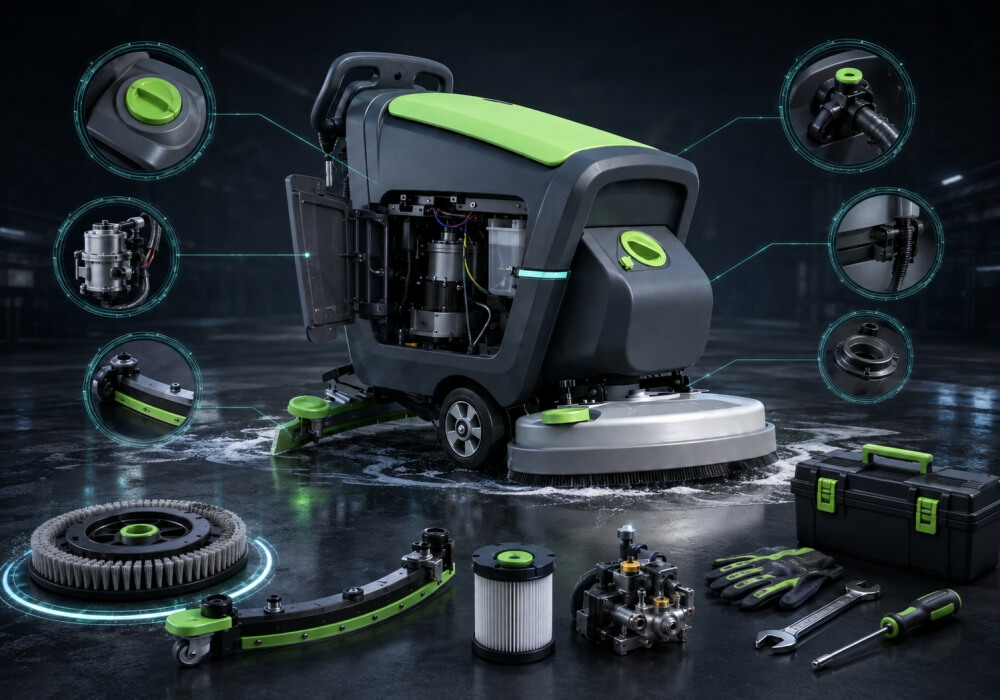
The 1950 vs LT-S2050S industrial sweeper comparison shows that the 1950 fits better in compact industrial spaces with tighter routes, while the LT-S2050S is designed for larger areas requiring wider coverage and longer operation. Site size, aisle width, turning space, and cleaning frequency should determine the choice. For facilities above 10,000 m², the larger capacity and working range of the LT-S2050S can improve daily cleaning efficiency, while the 1950 provides better access in areas with limited space.
Industrial sweeper selection depends on how the machine fits the working environment rather than size alone. The 1950 and LT-S2050S serve different facility layouts, with the 1950 focusing on flexible movement and the LT-S2050S focusing on wider-area cleaning. A warehouse built in 2024 with narrow storage lanes may require a different machine size compared with a 20,000 m² logistics center.
“A sweeper that matches the site layout can spend more time cleaning and less time repositioning.”
The 1950 is suitable for facilities where operators need frequent turns and access between equipment. Its compact structure helps it move through smaller passages, production areas, and mixed-use industrial floors. In spaces where aisle widths are around 2.5–3 meters, a smaller machine can maintain smoother routes and reduce unnecessary adjustments.
The LT-S2050S is better suited for open industrial areas where long cleaning paths are available. Large warehouses, airports, manufacturing plants, and parking facilities often have fewer physical restrictions, allowing a larger sweeper to maintain continuous operation. In areas above 8,000–10,000 m², wider cleaning coverage can reduce repeated passes.
The difference becomes clearer when looking at daily operating patterns. A facility that requires cleaning for 6–8 hours per day may benefit from higher capacity equipment because fewer stops are needed for dust disposal and maintenance. Some large industrial sites report that reducing service interruptions by 15–20 minutes per shift improves equipment availability by approximately 5%.
| Site Condition | 1950 | LT-S2050S |
|---|---|---|
| Small workshops | Excellent fit | Limited advantage |
| Narrow warehouse aisles | Strong maneuverability | Requires more space |
| Large factories | Suitable for detailed cleaning | Higher productivity |
| Open parking areas | Effective but slower | Better coverage |
| Frequent route changes | More flexible | Less efficient |
Machine dimensions influence how much usable cleaning area can be reached. A larger sweeper may have a wider cleaning path, but the available space must allow safe turning. If a machine needs multiple adjustments at every corner, the theoretical cleaning width cannot fully improve daily output.
For example, a production facility with 5,000 m² of floor space but many machines, storage racks, and pedestrian zones may achieve better results with the 1950. A 25,000 m² distribution center built with wide transport lanes may use the LT-S2050S more efficiently because the machine can operate at a stable speed for longer distances.
The 1950 vs LT-S2050S industrial sweeper comparison also involves storage and maintenance requirements. Smaller sweepers usually need less parking space and can be stored closer to working areas. This is useful for facilities with limited equipment rooms or multiple cleaning zones.
The LT-S2050S requires more available space but provides advantages when cleaning schedules involve large surface areas. A machine that covers more square meters per hour can reduce the number of cleaning cycles required each week. For a facility operating 300 days per year, even a 10% improvement in daily cleaning efficiency can save significant operating time.
“The best machine size depends on the distance it can clean effectively inside the actual facility layout.”
Floor conditions also affect the suitable model. Industrial sites with metal particles, packaging waste, dust accumulation, or frequent vehicle movement may need longer operating periods and larger collection capacity. The LT-S2050S can support these conditions in larger environments where debris levels remain consistent across wide areas.
The 1950 works well in locations where cleaning requirements change throughout the day. Retail warehouses, maintenance areas, and smaller manufacturing floors often contain different surface conditions within short distances. A compact sweeper allows operators to change routes quickly without requiring large turning areas.
Battery performance and working time are also related to machine size. In an 8-hour shift, frequent charging or disposal stops can reduce available cleaning time. Larger industrial sweepers are often selected for facilities where continuous operation is required, while compact models are preferred when flexibility matters more than maximum coverage.
A comparison based on typical application areas can be shown below:
| Application | Preferred Feature |
|---|---|
| Automotive workshops | Compact movement around equipment |
| Food processing facilities | Easy access and regular cleaning |
| Logistics warehouses | Longer working range |
| Commercial parking facilities | Wider cleaning path |
| Manufacturing plants | Balance between access and capacity |
The layout of the facility should be measured before selecting equipment. Important measurements include narrowest aisle width, turning radius availability, storage location, charging position, and average cleaning distance. A difference of only 20–30 cm in machine width can affect whether the equipment can enter certain areas.
Safety requirements also influence equipment selection. In workplaces with forklifts, workers, and moving materials, operators need enough space to control the machine smoothly. The 1950 provides advantages in crowded environments because it can adjust routes more easily. The LT-S2050S performs better when traffic patterns are organized and cleaning areas are clearly separated.
Industrial cleaning requirements have changed as facilities become larger and more specialized. Since 2020, many warehouses and production sites have increased automation levels, creating more structured floor layouts. These environments often provide wider paths where larger sweepers can operate efficiently.
The choice between the 1950 and LT-S2050S should match the relationship between machine size and daily cleaning conditions. The 1950 provides practical performance for compact and complex spaces, while the LT-S2050S supports higher coverage requirements in large open facilities.
For sites below approximately 5,000–8,000 m² with frequent obstacles, the smaller model may provide better overall usability. For facilities above 10,000 m² with long straight routes, the larger model can reduce cleaning time and improve working consistency. Selecting the correct size helps operators maintain regular cleaning schedules without unnecessary equipment limitations.