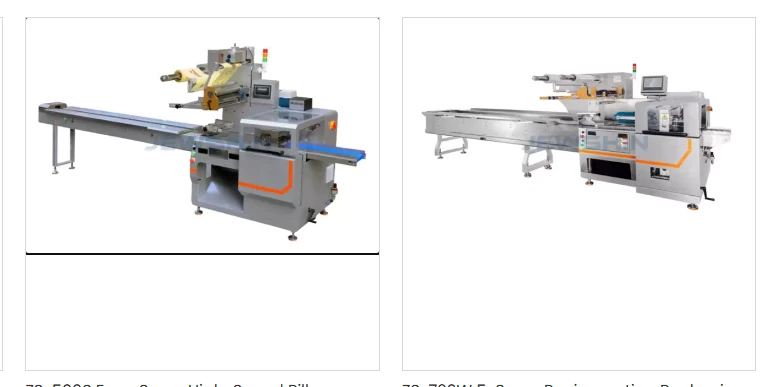
Automatic packaging machines handle fast size and format changes by storing SKU settings in recipes, repositioning servo-controlled axes, using motorized guides, and limiting manual work to a small set of change parts. A well-designed line can recall dozens or hundreds of parameters at once, including product pitch, film length, sealing temperature, cutter position, guide width, label location, and inspection limits. On a line running 120 packs per minute, reducing one changeover from 30 to 10 minutes preserves 2,400 production cycles. The practical target is the first acceptable pack after the switch, not simply the moment the machine restarts.
Packaging plants have moved away from relying only on long runs of one SKU. A line may handle 200 g, 400 g, and 800 g products using different film widths, package lengths, print layouts, or secondary packs during the same week. If a plant completes four 25-minute changeovers in an 8-hour shift, more than 20% of scheduled time can disappear before cleaning and unplanned stops are counted.
That lost time explains why modern equipment stores format settings as machine recipes rather than asking operators to rebuild settings from paper records. A recipe may contain 50, 100, or more machine parameters, depending on line complexity, and selecting a new SKU can update multiple electronic settings from one HMI command.
Typical stored settings include:
-
product pitch, conveyor speed, and index distance;
-
film length, registration offset, and cutting position;
-
fill quantity or target weight;
-
sealing temperature, pressure, and dwell time;
-
guide, rail, and sealing-head positions;
-
label and date-code locations;
-
inspection tolerances and reject settings.
Recipe control removes repeated data entry, but stored numbers alone cannot move physical equipment. Servo motors and electrically positioned mechanisms handle that part of the change. A machine designed in 2026 can electronically reposition several axes while an operator deals with the smaller number of components that still require physical replacement.
A 150 mm product, for example, may need a different pitch from a 220 mm product. On older mechanically synchronized equipment, changing that relationship can involve gears, chains, sprockets, cams, or manual adjustments. Servo-based equipment can store both motion profiles and recall the correct positions when the operator changes the recipe.
At 100 packs per minute, every 6 minutes spent adjusting timing represents 600 theoretical package cycles. Replacing repeated mechanical timing work with stored axis positions removes that adjustment from every later changeover of the same format.
Film packaging shows why coordinated adjustment matters. Changing product length affects film advance, product spacing, sealing-jaw timing, print registration, and cut position together. A horizontal flow wrappe can therefore use electronically synchronized product feeding, film transport, sealing, and cutting rather than treating each setting as an isolated adjustment.
The same principle applies to width and height. Cartoners, case packers, tray systems, and conveyors may have side rails, upper guides, compression belts, magazines, or sealing heads that must move when package dimensions change. Motorized positioning lets the machine send those assemblies to stored coordinates instead of requiring several handwheel adjustments.
Consider six manual adjustment points requiring 90 seconds each. Sequential adjustment consumes 9 minutes before verification. If five points are automatically repositioned within 60 seconds while one manual component is changed, the elapsed setup period can fall by more than 80% for that part of the procedure, although actual results depend on machine layout and safety requirements.
Not every component can be electronically repositioned. Forming sets, sealing jaws, filling nozzles, product pockets, star wheels, vacuum tooling, and guide plates may have geometry specific to one package family. Equipment manufacturers therefore use repeatable mechanical interfaces to shorten the physical portion of a format change.
Tool-free clamps, locating pins, keyed mounts, captive fasteners, and preset stops reduce the number of operations required. If replacing four parts takes 3 minutes each, the machine loses 12 minutes. Bringing each replacement down to 60 seconds reduces the same operation to 4 minutes, a 67% reduction before restart checks are included.
| Changeover area | Older approach | Automated or quick-change approach |
|---|---|---|
| Product pitch | Gear or mechanical timing adjustment | Stored servo position |
| Guide width | Handwheel measurement | Motorized preset |
| Film length | Manual timing adjustment | Recipe setting |
| Tool identification | Operator inspection | RFID/barcode confirmation |
| Registration | Trial packs and correction | Sensor-based correction |
| Format instructions | Paper setup sheet | HMI sequence |
Faster mechanics still need verification because one wrong component can produce hundreds of defective packs before an operator notices the problem. At 150 packs per minute, only 4 minutes of incorrect setup can expose 600 packs to incorrect sealing, cutting, labeling, or positioning.
Modern machines therefore check their own configuration with proximity sensors, encoders, photoelectric sensors, RFID tags, barcode readers, pressure sensors, temperature measurement, and vision systems. A coded change part can be compared with the active SKU before production is permitted to start.
A format change completed in 7 minutes but followed by 5 minutes of rejected production is not a 7-minute changeover. Measured from the last acceptable pack of SKU A to the first stable acceptable packs of SKU B, the production interruption is closer to 12 minutes.
Verification becomes more important when packaging materials also change. A new film can have different thickness, friction, print pitch, or sealing behavior. A recipe can provide the starting settings, while registration sensors and temperature controls help maintain the new operating condition after material is loaded.
Suppose printed film repeats every 250 mm and the registration mark is initially displaced by 5 mm. That is a 2% positional error relative to the repeat length. Registration control can measure the mark and correct film position without asking an operator to repeatedly stop the line, move the setting, produce samples, and inspect them.
Inspection equipment also needs its own format information. A 300 g package and a 500 g package cannot share the same checkweigher target, while different label designs may require different vision regions or code checks. Changing the physical machine without changing inspection parameters leaves the line only partly converted.
For that reason, integrated lines distribute SKU information across filling, wrapping, labeling, coding, checkweighing, vision inspection, case packing, and rejection equipment. A plant running 40 SKUs benefits from maintaining 40 validated parameter sets rather than asking each shift to recreate settings at every module.
However, automation does not remove the operator. It changes what the operator spends time doing. Instead of manually finding dozens of positions, the operator can concentrate on material replacement, sanitation, tooling changes, visual checks, and confirmation that the correct packaging components have been installed.
HMI-guided procedures can present each required step in order. A screen might request forming set B, show a target rail position of 245 mm, request 400 mm film, confirm jaw type 03, and prevent the next stage until required conditions have been acknowledged or detected.
That standardization matters across shifts. If three operators each use a slightly different method, a nominal 10-minute setup can become 8 minutes on one shift and 18 minutes on another. Stored procedures reduce dependence on memory and make deviations easier to identify from machine records.
The sequence of work matters just as much as individual adjustment speed. Packaging material, labels, change parts, tools, and cleaning supplies can often be prepared before the previous run ends. Work that requires the machine to be stopped should occupy as much of the shutdown window as necessary, but preparation does not have to wait for that window.
For example, a plant running an 8-hour shift has 480 scheduled minutes. Four 20-minute changes consume 16.7% of the shift. Reducing each to 8 minutes returns 48 minutes to the schedule, equivalent to 4,800 theoretical cycles on a 100-pack-per-minute machine.
Several operations can also overlap where the machine design and safety system permit it. While electronically controlled rails move to their stored positions, an operator may prepare the next roll or replace an accessible change part under the equipment maker's approved procedure.
The calculation is straightforward. A 70-second automatic positioning task followed by a separate 100-second manual task takes 170 seconds. Where both are designed to occur during the same safe changeover stage, elapsed time approaches 100 seconds, about 41% less than completing them one after another.
Restart performance deserves the same attention as mechanical setup. Traditional changeovers may involve producing samples, checking seal position, adjusting registration, changing fill settings, and repeating the process. Five rounds of 20 sample packs already consume 100 packages without adding any saleable output.
Closed-loop measurement can reduce repeated correction. A checkweigher can provide weight information to a filler, registration sensors can correct film position, and vision systems can check print, label, or package location. The machine starts from stored parameters and uses measured conditions to make permitted corrections.
Data collection then shows where time is actually being spent. Modern controllers can record the last pack of the previous SKU, recipe selection, axis positioning, operator confirmations, alarms, first restart, reject counts, and the point at which nominal speed is reached.
If 30 recorded changeovers average 14 minutes against a planned 9 minutes, the event history can separate mechanical adjustment from material loading, registration, cleaning, or restart delays. A repeated 4-minute registration delay across 30 samples represents 120 minutes of accumulated downtime, giving engineers a measurable problem to address.
The same records help compare package families. A small-to-medium format change might require only recipe selection and automatic guide movement, while a medium-to-large change could require a forming set, wider film, different sealing jaws, and another case-packing configuration. Treating both as one generic “changeover” hides the engineering difference.
Machine design should therefore be evaluated using real SKU combinations rather than only maximum packaging speed. A machine rated at 180 packs per minute but requiring 35 minutes for frequent conversions can provide fewer available production minutes than a 160-pack-per-minute machine completing the same changes in 10 minutes.
For a simple 8-hour example, six 35-minute changes consume 210 minutes, leaving 270 minutes before other losses. Six 10-minute changes consume 60 minutes, leaving 420 minutes. The second setup provides 55.6% more available running time in that simplified comparison even though its stated maximum speed is lower.
Format flexibility also depends on how much adjustment remains mechanical. Buyers can ask how many manual change points exist, which require tools, how many settings are recipe-controlled, whether change parts have positive location features, and whether the machine verifies installed components before restart.
They can also request a witnessed changeover using representative products. Testing only one familiar SKU provides limited information. A more useful acceptance exercise can include at least 3 format changes covering small-to-large, large-to-small, and material changes while recording the last good pack, first good pack, waste quantity, operator interventions, and time to rated speed.
Those measurements expose differences that a machine brochure cannot show. Two systems may both claim “quick changeover,” while one requires 15 manual positions and another requires four. Counting adjustment points, measuring elapsed time, and recording rejected packs gives the comparison a numerical basis.
Maintenance affects repeatability as well. Worn locating pins, loose guides, contaminated sensors, backlash, or damaged tooling can make a previously stable recipe produce different results months later. Preventive inspection should therefore cover the mechanical reference points that allow stored electronic settings to correspond with real physical positions.
A guide axis that is 2 mm away from its expected location may appear minor, but on a 50 mm package it represents a 4% dimensional difference. Position feedback and scheduled mechanical checks help keep recipe-based changes repeatable rather than allowing gradual mechanical wear to turn into recurring setup correction.
For plants handling frequent SKU changes, the useful performance measure remains elapsed time from the final acceptable package of one run to stable acceptable production of the next. Servo positioning, recipes, quick-change tooling, sensors, HMI instructions, inspection feedback, and recorded changeover data each remove a different portion of that interval.
A reduction from 25 minutes to 10 minutes saves 15 minutes per event, or 60%. Across five daily changes and 250 operating days, that equals 18,750 minutes—312.5 hours—of additional scheduled time before applying the plant's actual production rate, efficiency, labor cost, and material cost.